
Simulcast to 3rd party platforms
Learn how to simulcast FastPix live streams to YouTube Live, Facebook Live, and Twitch using RTMP/RTMPS, OBS, and simulcast webhook events.
What is simulcasting?
Simulcast lets you broadcast a single live video to multiple platforms at the same time such as YouTube Live, Facebook Live, and Twitch. Instead of running separate streams for each platform, you stream once from FastPix and we distribute it to all your chosen destinations.
Benefits of simulcasting:
- Maximize your audience reach across platforms
- Save time by managing one stream instead of multiple
- Maintain consistent content across all channels
- Simplify your streaming workflow
What you'll do
In this guide, you will:
- Create simulcast targets using the FastPix API
- Add RTMP or RTMPS URLs and stream keys for third-party platforms
- Configure OBS to broadcast a live stream
- Monitor simulcast status using webhook events
Choose a simulcast workflow
You can configure. simulcast in one of the following ways:
- Create simulcasts targets before starting the live stream
- Start the livestream, then add simulcasts targets
Option 1: Create simulcasts targets before starting the live stream
Use this option when you know all destination platforms in advance. This ensures the live stream is published to all platforms as soon as it starts.
Example: You're hosting a product launch and want viewers on YouTube, Facebook, and LinkedIn to watch simultaneously. Configure all three simulcasts in advance, then start your stream. All platforms receive the broadcast at the same time.
Best for:
- Scheduled or planned events
- Maximum reach from the very beginning
- Avoiding mid-stream configuration
Option 2: Start the livestream, then add simulcasts
Use this option when you want to test the stream or delay publishing to additional platforms.
Example: You start streaming on YouTube to test everything. Once you confirm the stream works well, you add Facebook and Twitch as simulcast targets.
Best for:
- Last-minute changes
- Gradual rollout across platforms
- Testing before going fully live
For details on the full API definition, request parameters, and response structure, see the Create simulcast of stream API reference.
Supported simulcast targets
FastPix supports simulcasting to third-party platforms that accept RTMP or RTMPS input. Each platform provides a unique stream key and stream URL.
Currently supported platforms include:
- YouTube Live
- Facebook Live
- Twitch
NOTE
We’re constantly upscaling our APIs and adding more simulcast targets from other popular platforms. Contact FastPix support if you require support for a specific platform.
How to simulcast your live stream
To simulcast a FastPix live stream, create a simulcast target using the Create simulcast API. You can add simulcast targets before or after creating a live stream.
NOTEYou can add simulcast targets only when the live stream status is
idle.
Simulcast API request parameters
url
- It acts as the destination address your live stream uses to connect to a third-party streaming service.
- It tells your live stream where to send the video and how to reach its destination on the internet.
streamKey:
- When you stream to a specific platform, it provides a unique RTMPS url and a streamKey. You use these two values together to establish the connection.
- This connection sends your live video to the platform for playback. Each platform has its own RTMPS URL and stream key, which together authorize broadcasting to that destination.
metadata:
- Stores additional details about the live stream, such as its title, category, or any other relevant information.
Create a simulcast target
Request example to create a simulcast:
curl -X POST 'https://api.fastpix.io/v1/live/streams/{streamId}/simulcast'
   --user {Access Token ID}:{Secret Key} \
   -H 'Content-Type: application/json' \
   -d '{
   "url": "rtmp://hyd01.contribute.live-video.net/app/",
   "streamKey": "live_1012464221_DuM8W004MoZYNxQEZ0czODgfHCFBhk",
   "metadata": {
      "livestream_name": "Tech-Connect Summit"
   }
}'
Response example:
{
  "success": true,
  "data": {
    "simulcastId": "830d4d03c771539cbe491e1026e3c033",
    "url": "rtmp://hyd01.contribute.live-video.net/app/",
    "streamKey": "live_1012464221_DuM8W004MoZYNxQEZ0czODgfHCFBhk",
    "isEnabled": true,
    "metadata": {
      "livestream_name": "Tech-Connect Summit"
    }
  }
}
After creating a simulcast target, configure your broadcasting software to start streaming.
The following examples show RTMP URLs and stream keys for various streaming platforms
Simulcast to YouTube Live
Get YouTube credentials
- Go to YouTube Studio
- In the top right corner of the page, click Create > Go live
- Choose Stream (not the webcam option)
- Copy your RTMP URL and Stream key
NOTE
The streamKey is intended for a single use on each platform; once the stream concludes, it becomes inactive. It is advisable to regularly reset the streamKey for optimal functionality.
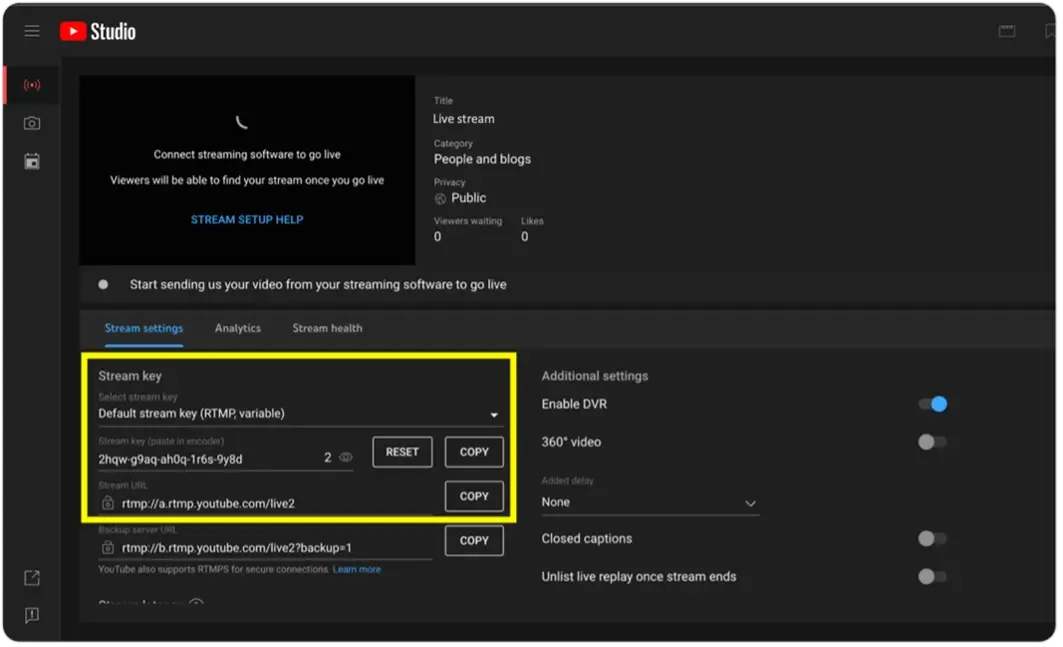
- RTMP URL: rtmp://a.rtmp.youtube.com/live2
- Stream Key: 2hqw-g9aq-ah0q-1r6s-9y8d
curl -X POST 'https://api.fastpix.io/v1/live/streams/{streamId}/simulcast' \
   --user  {Access Token ID}:{Secret Key} \
   -H 'Content-Type: application/json' \
   -d '{
    "url": "rtmp://a.rtmp.youtube.com/live2/37q0-tvp6-4ju3-47dk-318b",
    "streamKey": "37q0-tvp6-4ju3-47dk-318b",
    "metadata": {
        "Key1": "567",
        "Key2": "567"
    }
}'
Response example
{
    "success": true,
    "data": {
    "simulcastId": "8717422d89288ad5958d4a86e9afe2a2",
    "url": "rtmp://a.rtmp.youtube.com/live2/37q0-tvp6-4ju3-47dk-318b",
    "streamKey": "37q0-tvp6-4ju3-47dk-318b",
    "isEnabled": true,
    "metadata": {
    "Key1": "567",
    "Key2": "567"
     }
}
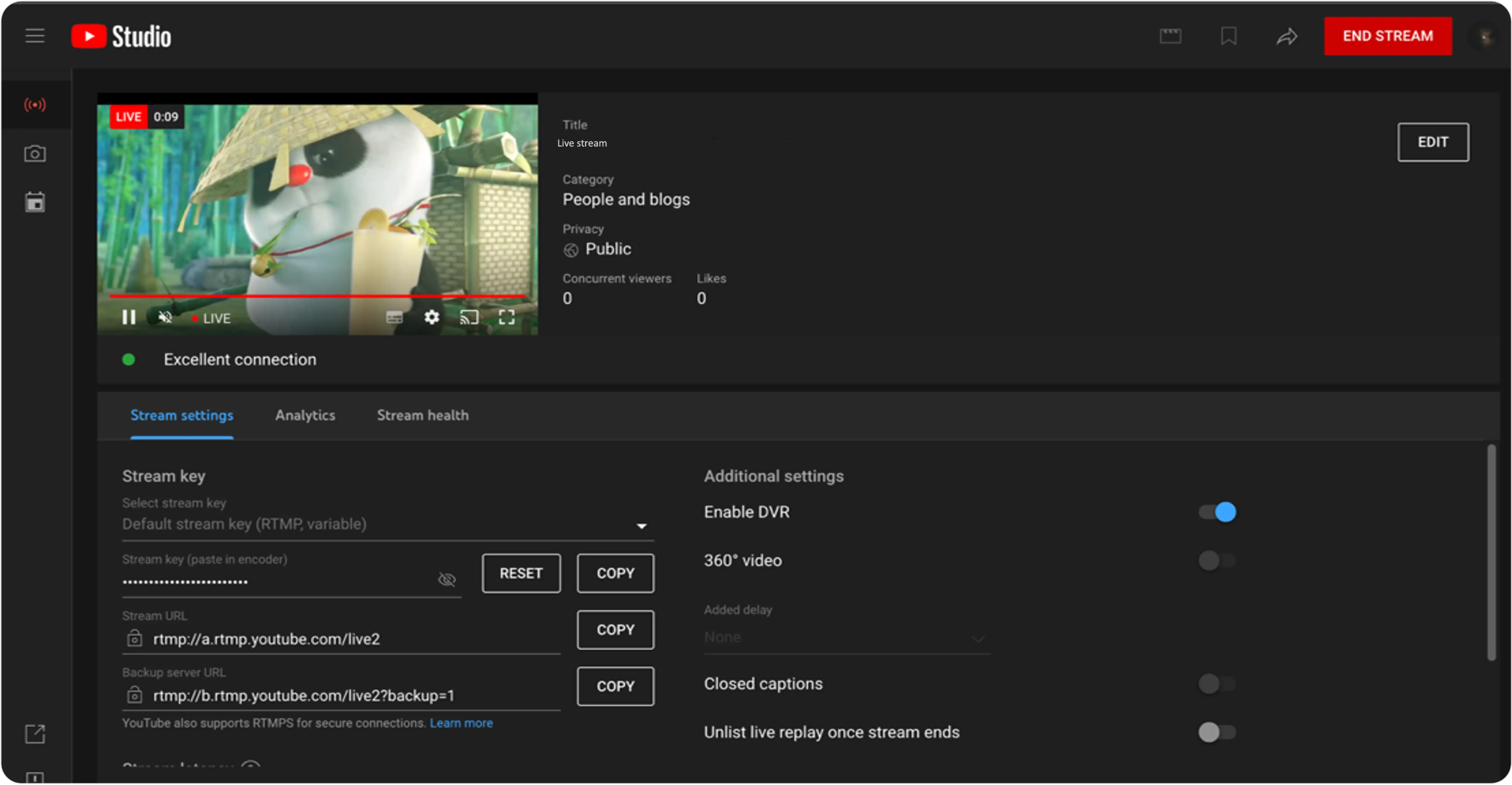
After creating the simulcast, configure your broadcasting software
Example: Live streaming in YouTube
Simulcast to Facebook Live
Get Facebook credentials
- Go to Facebook
- Click Live Video in the create post section
- Select streaming software
- Copy your Server URL and Stream key
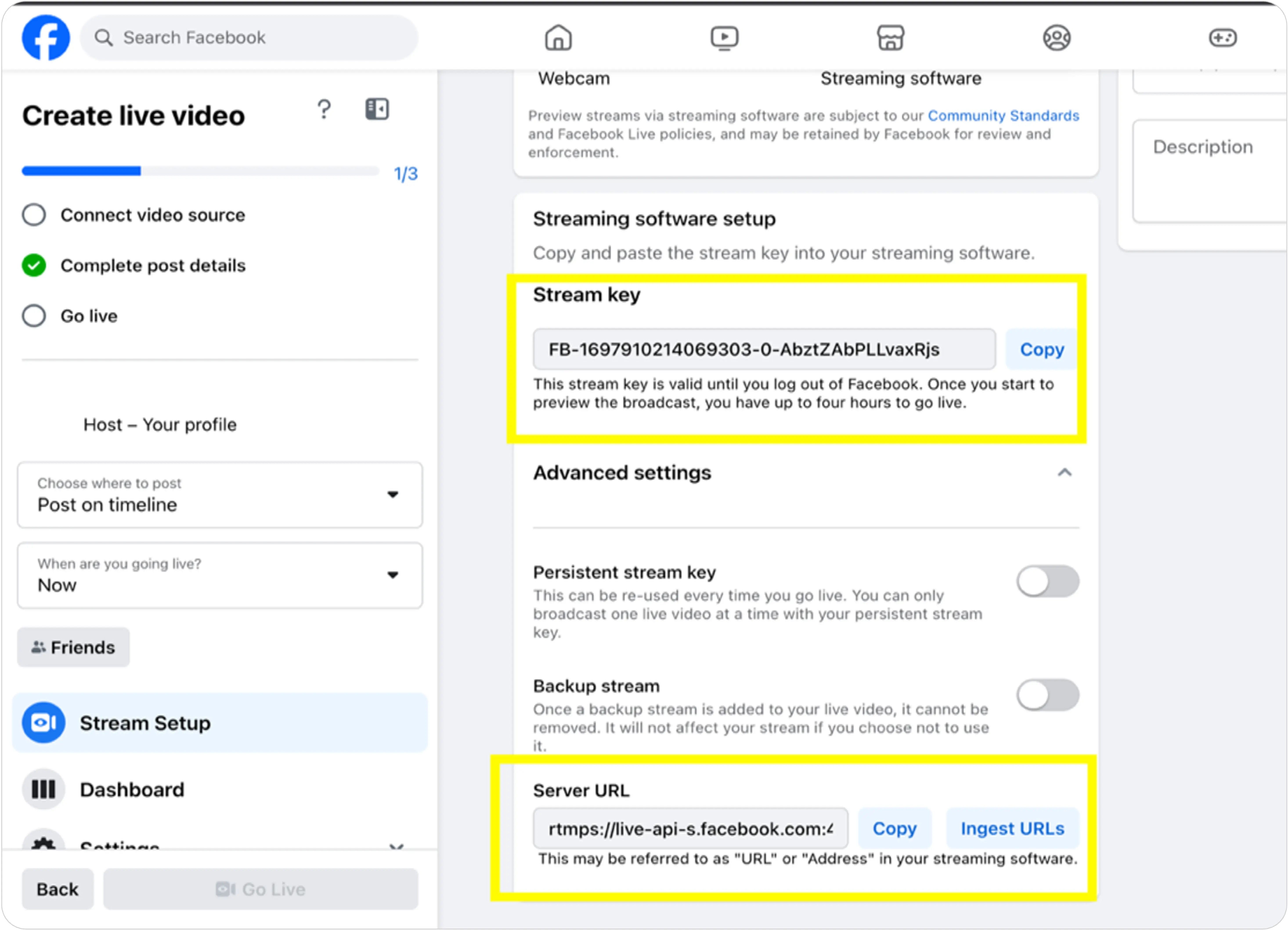
- RTMP URL: rtmps://live-api-s.facebook.com:443/rtmp/
- Stream Key: FB-1697910214069303-0-AbztZAbPLLvaxRjs
curl -X POST 'https://api.fastpix.io/v1/live/streams/{streamId}/simulcast' \
   --user {Access Token ID}:{Secret Key} \
   -H 'Content-Type: application/json' \
   -d '{
    "url": "rtmps://live-api-s.facebook.com:443/rtmp/FB-1729821800878144-0-Abw5V0aoUI7NK0SD",
    "streamKey": "FB-1729821800878144-0-Abw5V0aoUI7NK0SD",
    "metadata": {
        "Key1": "567",
        "Key2": "567"
    }
}'{
"success": true,
"data": {
"simulcastId": "fcbb943ac4b6409b38091f39f3e84ac1",
"url": "rtmps://live-api-s.facebook.com:443/rtmp/FB-1729821800878144-0-Abw5V0aoUI7NK0SD",
"streamKey": "FB-1729821800878144-0-Abw5V0aoUI7NK0SD",
"isEnabled": true,
"metadata": {
"Key1": "567",
"Key2": "567"
}
}
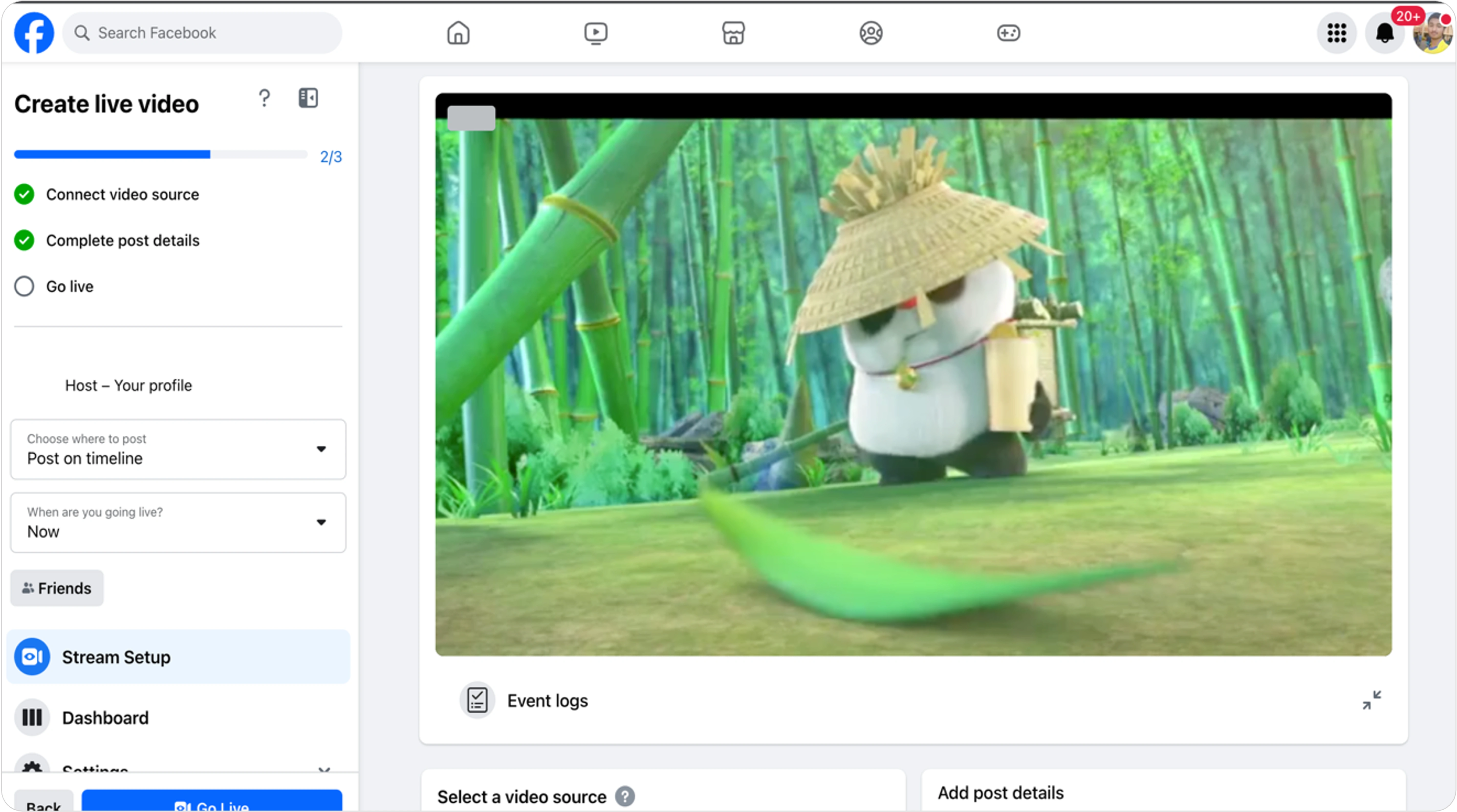
}After creating the simulcast, configure your broadcasting software
Example: Live streaming in Facebook
Simulcast to Twitch
Get Twitch credentials
- Go to Twitch creator dashboard
- Click settings > Stream
- Copy your Server URL and Stream key
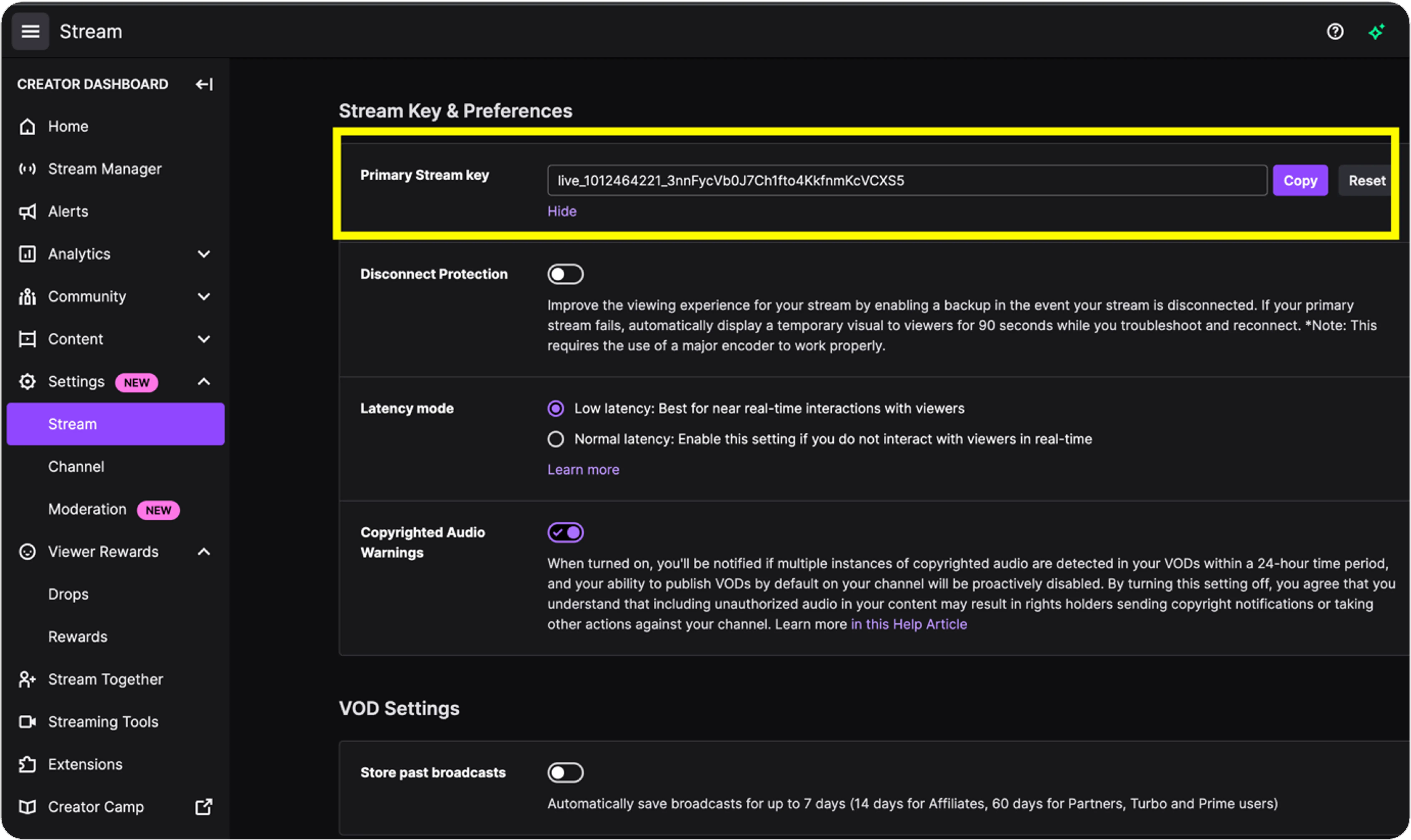
- RTMP URL: rtmps://live.twitch.tv/app
- Stream Key: live_1012464221_3nnFycVb0J7Ch1fto4KkfnmKcVCXS5
curl -X POST 'https://api.fastpix.io/v1/live/streams/{streamId}/simulcast' \
   --user {Access Token ID}:{Secret Key} \
   -H 'Content-Type: application/json' \
   -d '{
    "url": "rtmp://hyd01.contribute.live-video.net/app/live_1012464221_aJ9wwRkGeNQoHHe64Bfid8Ct7NZsUG",
    "streamKey": "live_1012464221_aJ9wwRkGeNQoHHe64Bfid8Ct7NZsUG",
    "metadata": {
        "Key1": "567",
        "Key2": "567"
    }
}'{
"success": true,
"data": {
"simulcastId": "0c377fc4e77d7cb701c098883bd4f0a5",
"url": "rtmp://hyd01.contribute.live-video.net/app/live_1012464221_aJ9wwRkGeNQoHHe64Bfid8Ct7NZsUG",
"streamKey": "live_1012464221_aJ9wwRkGeNQoHHe64Bfid8Ct7NZsUG",
"isEnabled": true,
"metadata": {
"Key1": "567",
"Key2": "567"
}
}
}After creating the simulcast, configure your broadcasting software
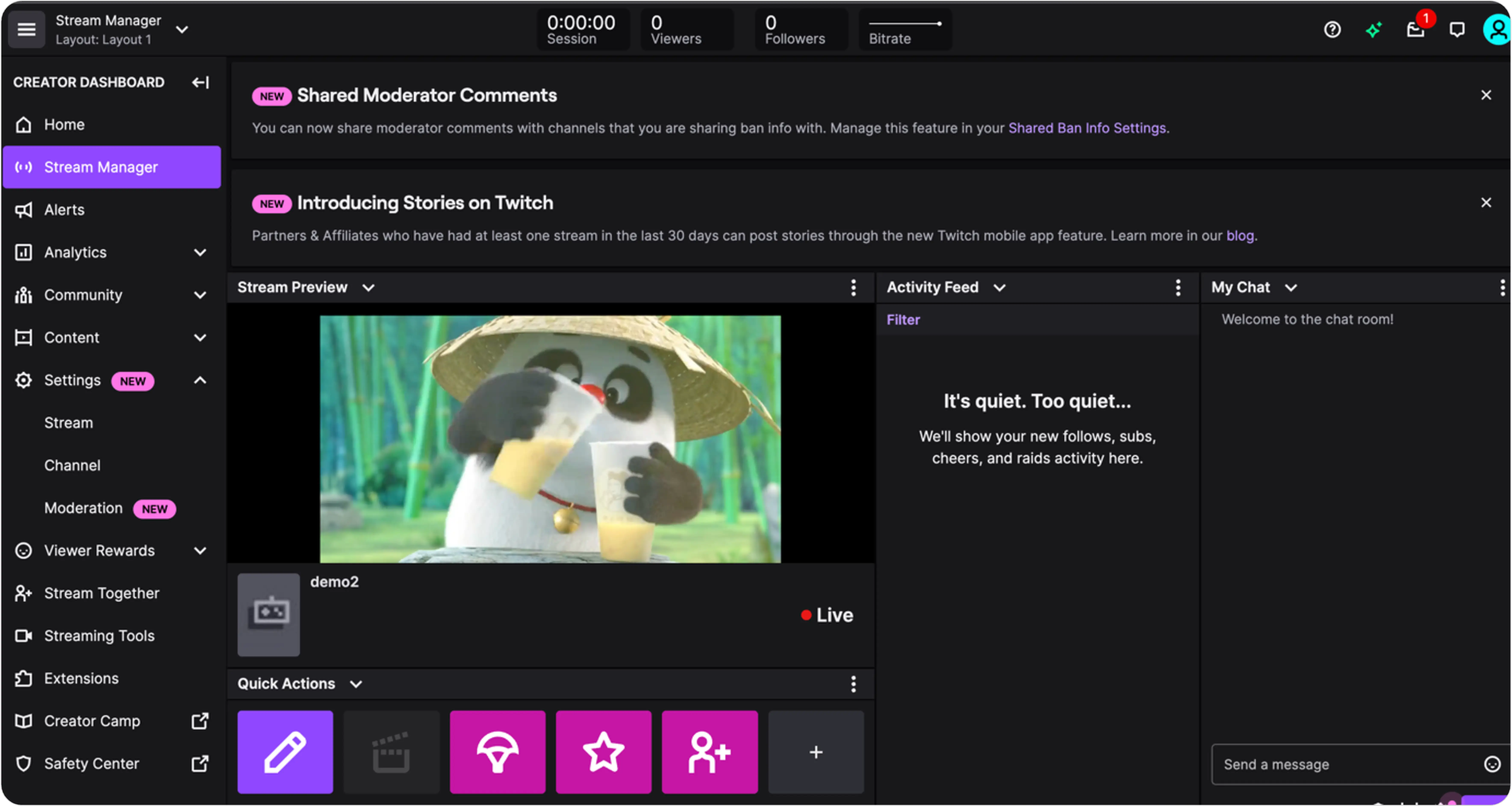
Example: Live streaming in Twitch
Configure OBS for broadcasting
After you set up your simulcast targets, configure the OBS (Open Broadcaster Software) or you can use any RTMP-compatible software.
Here are the steps you need to follow:
- Open OBS studio on your system
- Click Settings in the bottom-right corner
- Select Stream from the left menu
- Configure the following settings:
- Service: Custom
- Server:
rtmps://live.fastpix.io:443/live - Stream Key: Your FastPix stream key (from when you created your live stream)
- Click OK to save your settings
- Set up your video and audio sources (input that you want to stream).
- To start streaming click on “Start Streaming” in OBS. The stream will get started in all platforms simultaneously.
- To stop streaming, click “Stop Streaming” in OBS. The stream ends on all platforms simultaneously.
Simulcast events for status tracking
Simulcast target events help you build a user interface that shows real-time status updates for configured third-party endpoints. These events are especially useful when displaying the current state of each simulcast target and tracking status changes as they occur.
| Webhooks | Description |
|---|---|
| video.live_stream.simulcast_target.created | A new simulcast has been created for a live stream. |
| video.live_stream.simulcast_target.deleted | When the simulcast of a live stream has been deleted. |
| video.live_stream.simulcast_target.updated | When the simulcast of a live stream has been updated. |
Blog posts about simulcasting
We’ve published several blog posts that explore more simulcasting use cases and features.
- Simulcasting live video to multiple platforms
- 6 simulcasting tools to stream live across social platforms
Troubleshooting
Stream doesn't appear on a platform
Check the following:
- Verify the RTMP URL and stream key are correct
- Confirm the stream key is still valid (generate a new one if needed)
- Check that the simulcast target status is
enabled - Verify your account has permission to stream on that platform
Stream quality is poor on some platforms
Each platform has different encoding requirements. If one platform shows lower quality:
- Check the platform's recommended bitrate settings
- Verify your upload bandwidth can support multiple streams
- Consider reducing your output resolution if needed
Simulcast fails to create
Common causes:
- Stream is currently active (status isn't
idle) - Invalid RTMP URL or stream key format
- Network connectivity issues
- Platform-specific restrictions
Updated 3 months ago